
A couple of years ago, a number of students in my form class attended a climate march in Edinburgh. Clearly it was something they felt passionately about, enough to make posters and miss afternoon classes. When I probed deeper, I discovered their knowledge of the problems caused by climate change in Scotland was very surface level.
This is one of the reasons I decided to do this sabbatical – if pupils want to intelligently engage in discussions about their future and the climate, they (and we) need to be better informed about the impact of our actions, and what can be done, in Scotland, as the climate changes.
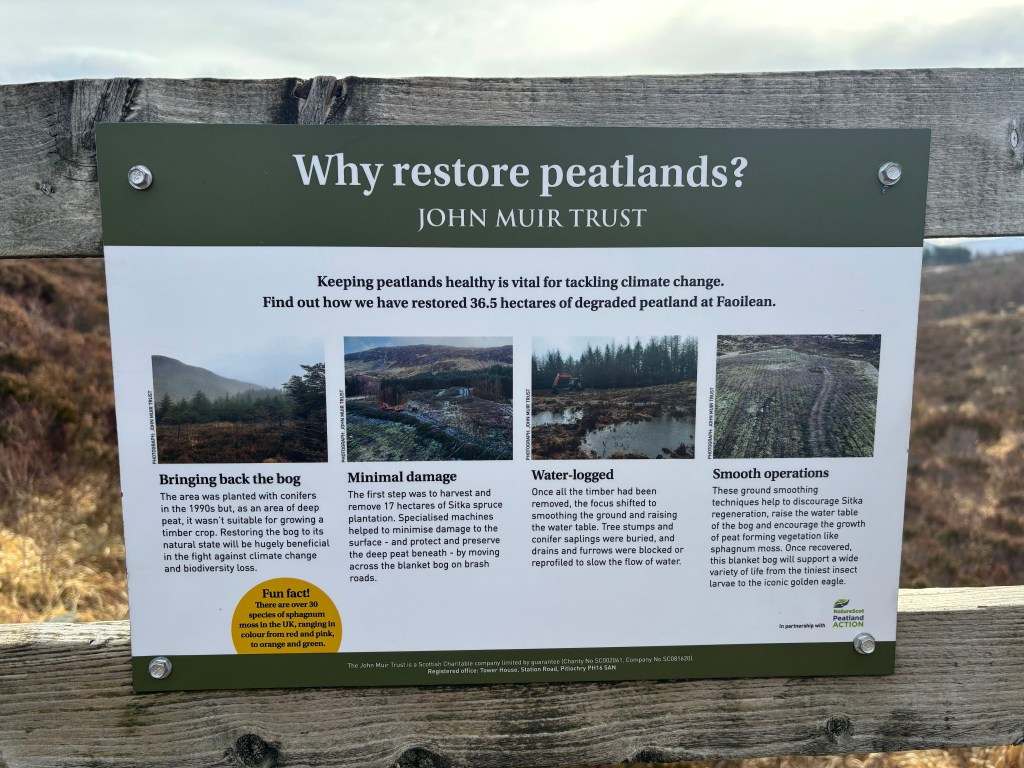
I was very interested to read this information board attached to a gate along my walk up Blaven. An incredible amount of work is involved in the restoration of peatland in this area, but it’s clearly a work that is possible, and will help tackle climate change.
Here are a few mind boggling facts:
80% of Scotland’s peatlands are damaged
Pentlands are the world’s largest tressestrial carbon store, capturing more than all the forests – they cover 3% of the surface, but account for 30% of the carbon store.
Vegetation grows on the thin, living surface layer, typically sphagnum mosses and cotton grass.
Speaking of sphagnum moss – the best story my good friend Graham Gibb told pupils on S3 Projects was how it was used in the 1st world war as a wound dressing to stave off sepsis.




 Physics teacher’s sabbatical
Leave a comment