
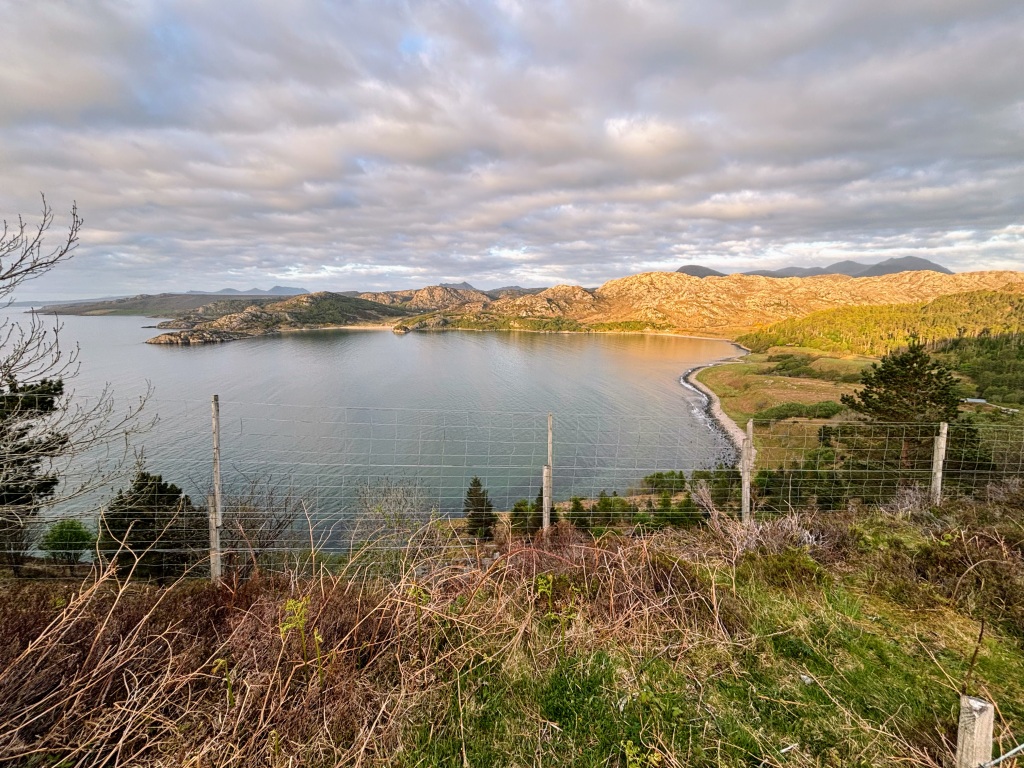
Wednesday 8th May was a quiet but very special day. After spending the previous day on the hills, I spent much of the day reading a book that Peter had lent me, Revival of the Land by Paul Ramsay.
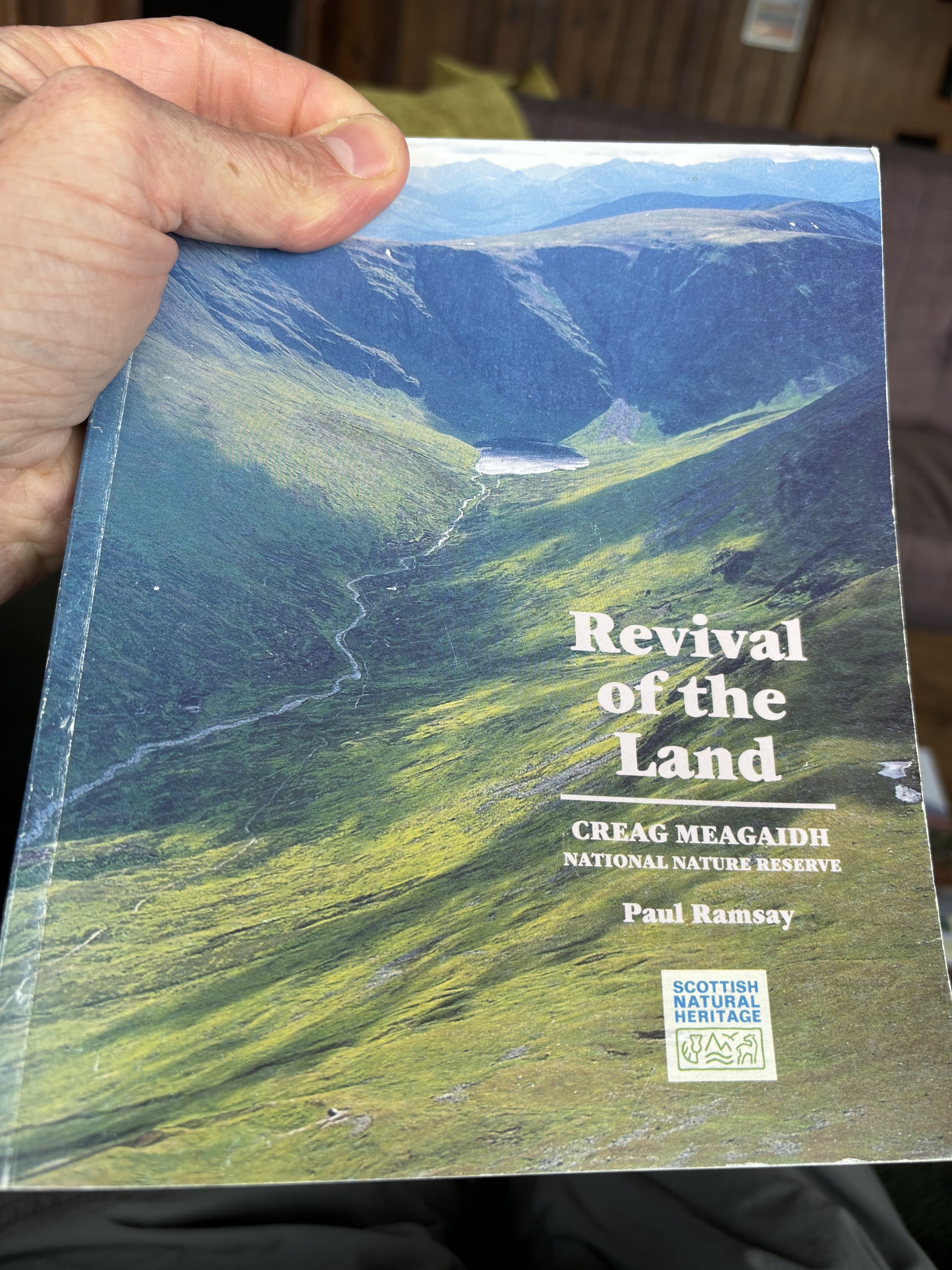
It tells the story of the first 10 years during which Creag Meagaidh became a National Nature Reserve. The link takes you to the nature.scot website, where you can find more up to date information on how the project is going. However the book is a fascinating read into the politics of purchasing land for the purposes of nature regeneration (perhaps a more plateable term for rewilding) and how Scottish National Heritage (SNH – which has since been rebranded as nature.scot) worked with neighbouring landowners as they reduced deer and sheep populations, re-introduced native species and began to increase biodiversity in the estate.
This quote sums it up…
Wherever sources of viable seed and suitable soil conditions coincide, there is the potential for natural regeneration of woodland up to and beyond the present tree line.
Revival of the Land, Paul Ramsay
This is not to say that there are not stretches of land where climatic and other contributory circumstances have led to the formation of blanket bog and, thus, an edaphic climax; an appropriate end point.
The ultimate goal is the re-establishment of a mosaic of dynamic habitats of which woodland is a part.
Perhaps my favourite quote from the book however is this line from Sir John Lister-Kaye, of Aigas.
‘Sir John Lister-Kaye has written of tracts of the Highlands that seem, through mismanagement due to overgrazing and overburning, to be reduced to ‘miles and miles of bugger all – MAMBA’
Creag Meagaidh is now very much on my must visit sites this coming June.
A night of celebration
Turns out, Wednesday 8th May was also Peter Cunningham’s 60th birthday, and he was hosting a ceilidh at the village community centre for all his friends. Well actually, he invited everyone in the local community, for it was mentioned on the local radio station that morning!
And as expected, the evening was a triumphant success! As an outsider, I was welcomed from the start – well, Peter announced my arrival to the entire hall, and within minutes of arriving I found myself on the dance floor enjoying the ceilidh! I sat down with the person I had just danced with, and she told me that she had only just discovered that the person she was sat next to was a classmate from the Watson’s class of 1980, whom she hadn’t seen since leaving school. They shared several classes together! We reminisced for some time, possibly to avoid getting up to dance, and talked at length about old teachers they both treasured. Dr Rodney Mallinson’s name came up as a favourite and she admitted that he was bit of a heart-throb amongst the female physics pupils! I remember Rodney fondly as one of my first mentors when I joined the school and he is dearly missed.
Without a doubt the highlight of the evening were the dancing interludes, where Peter, or members of his ceilidh band, would sing a song, read a poem or play a musical solo. Peter performed a couple of songs that he had written himself. I’ve included one here as it really fills me with joy to watch it. Peter is a genuinely warm and caring person, with a deep interest in nature and love for all creation. I think this song is a terrific example of how he sees the world, and how despite being an incredible expert in his field, he is incredibly humble and happy to laugh at himself.
Anyway, it was a very special night, and I was delighted to have been invited. Now, on to the subject of this post…
Sweep netting at Gruinard bay
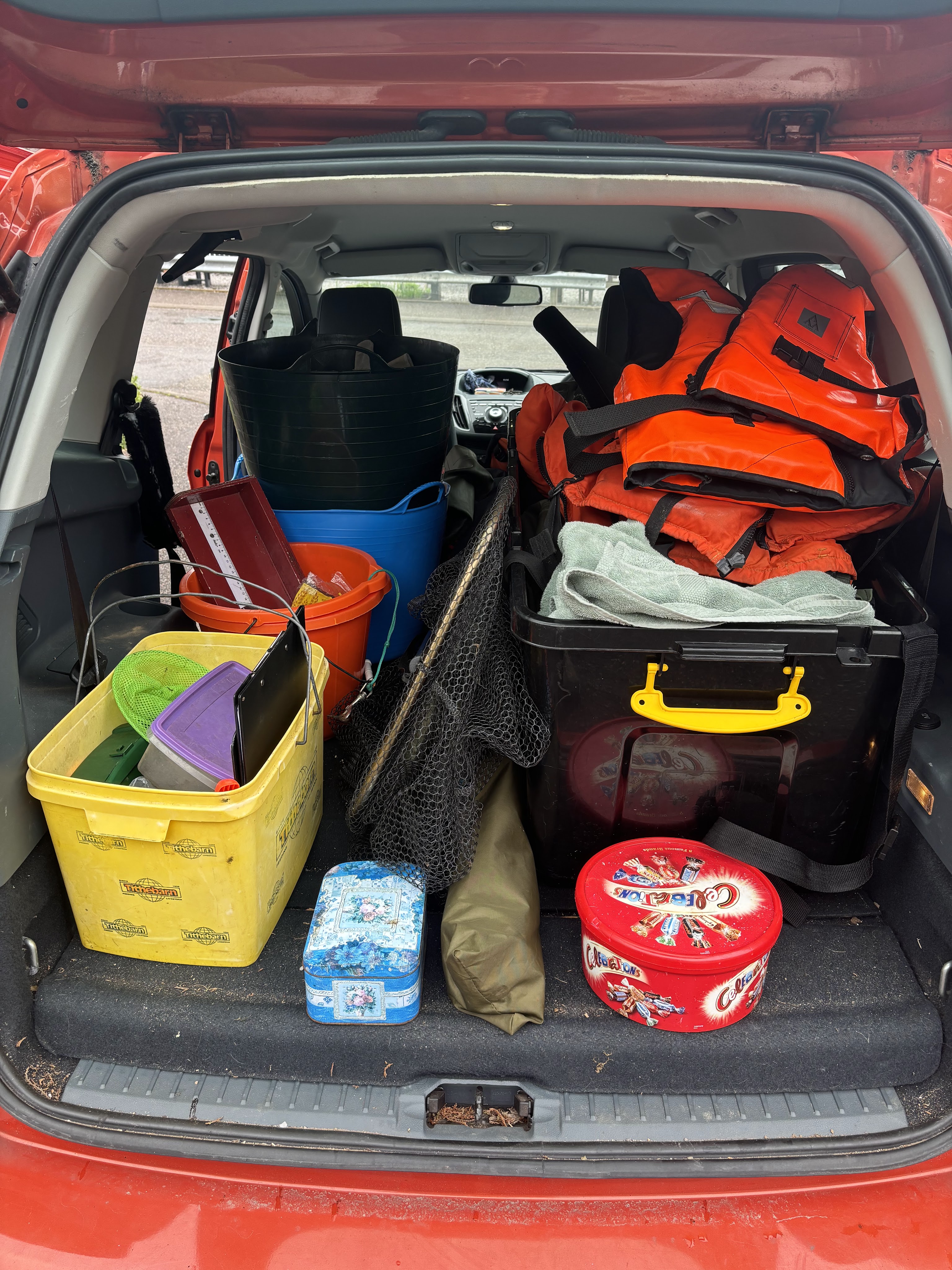
The morning after, on Thursday, Peter and I packed my functional (much more so than an SUV) Ford Grand C-Max to the gunnels with fishing gear, waders and left over cake from the birthday ceilidh, and headed to Gruinard Bay.
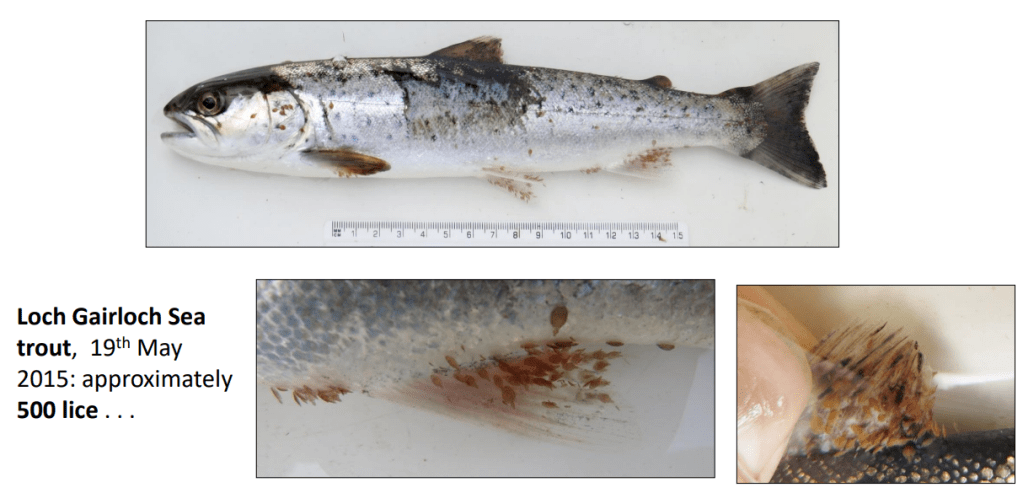
The purpose was to catch sea trout and examine them for sea lice. A good, simple summary can be found in a report (PDF) presented during a WRFT workshop on salmon, sea trout and related habitats by Peter in April this year in Torridon, a quote from which is presented below. The report emphasized the urgent need for progress to regulate sea lice on salmon farms to protect wild salmon populations especially around the Loch Torridon area and further south.
Sea lice are naturally occurring parasites of fish. They attached to salmon and sea trout and grow by eating mucus, blood and skin of their host fish.
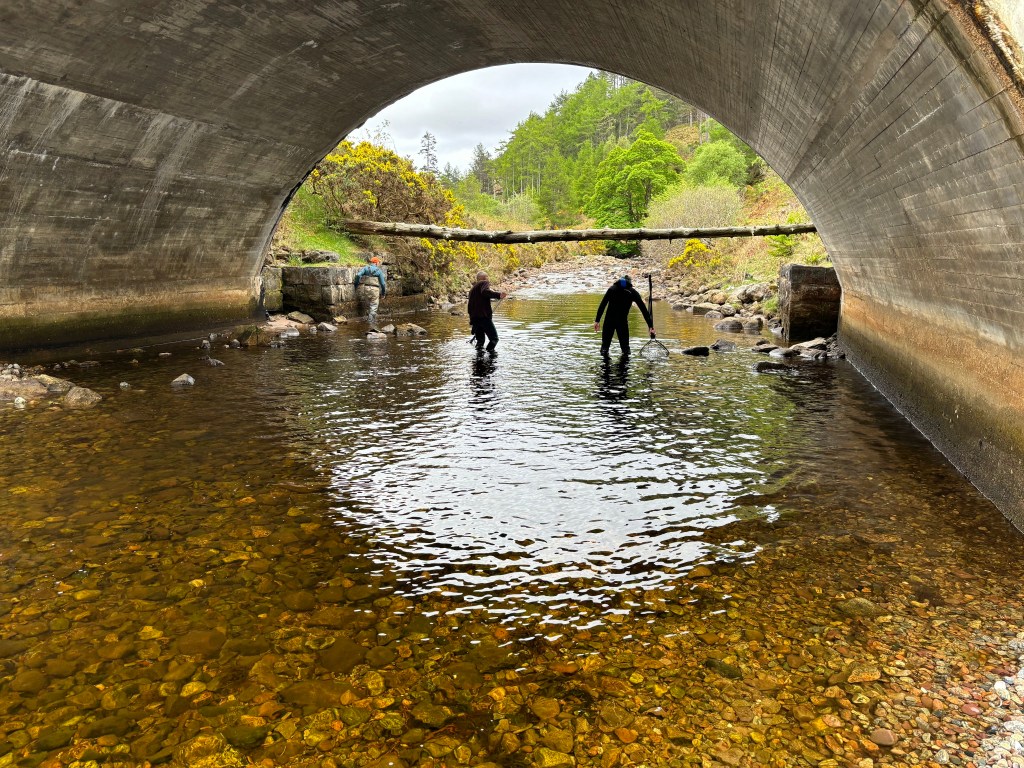
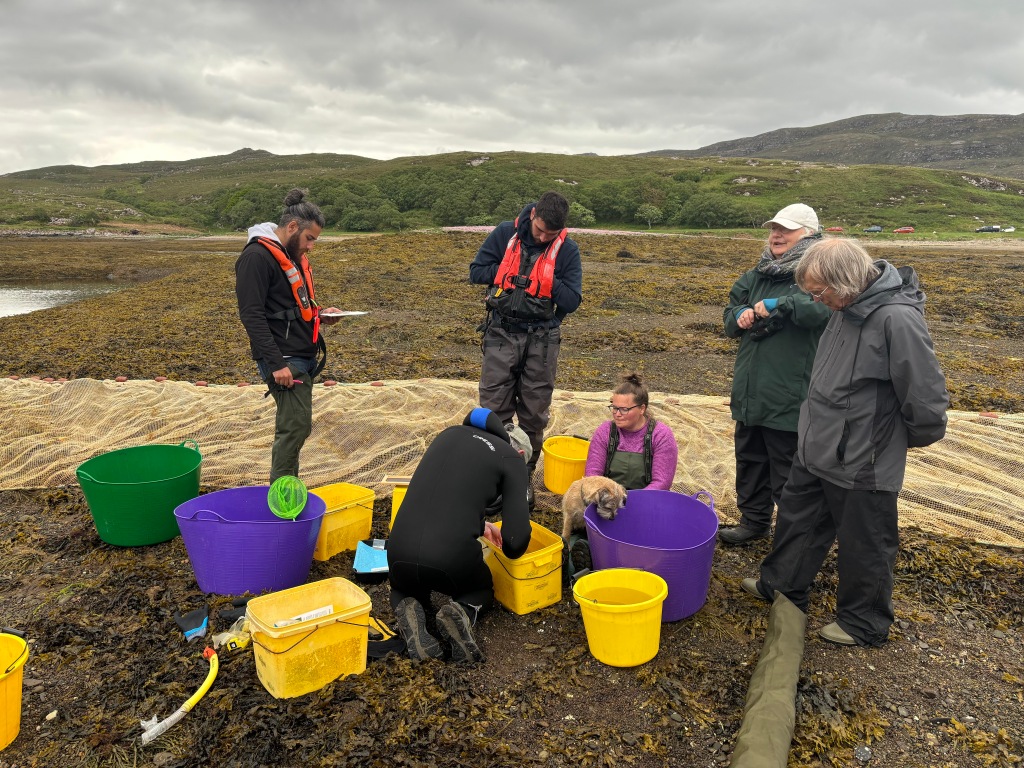
This was a new site for Peter, and he was uncertain how many fish we would be able to catch and examine. With a team of volunteers, and rather unusually a reporter from the Telegraph, who flew up from London to observe, we hauled an incredibly heavy net into the estuary and swept it through the water in the hope of catching some trout.
Success rate?
Zero!
However, amazingly, a few in the team managed to spot a couple of trout swimming back up the river inland, and one managed to corner one and catch it with his bare hands! After a few minutes in a bucket of sea water and some anaesthetic, we were able to take the fish out of the bucket and examine it for sea lice.
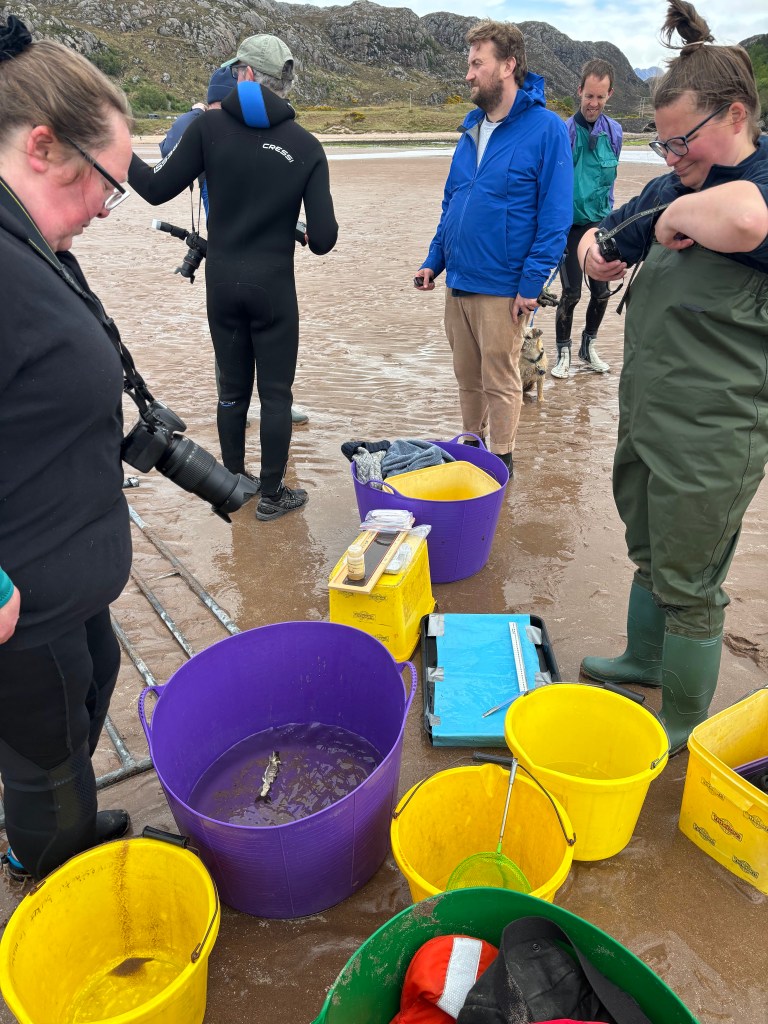
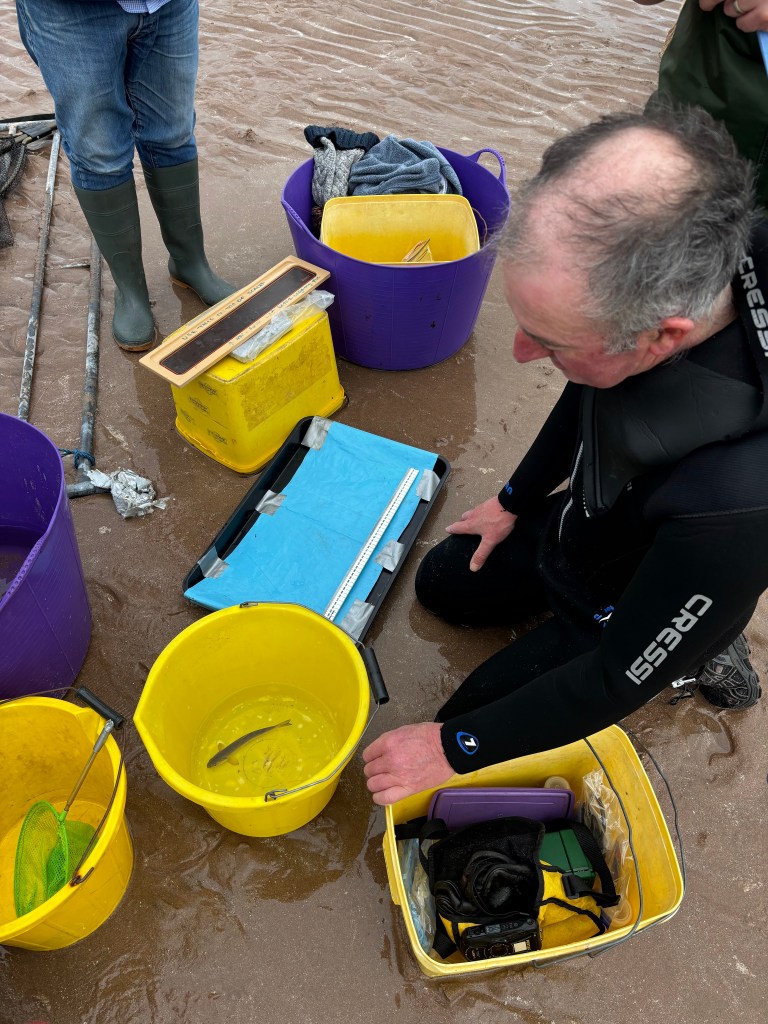
Peter examined the trout carefully. It was a young trout that had clearly not yet left the fresh water to enter the sea. Trout and salmon undergo a process known as smolting before entering the sea.
Young trout of 1 to 3 years old and 5 to 7 inches long will go through some physiological changes which includes the ability to cope with salt water and changing to a silver colour These small silver trout are called smolts. Smolts will shoal together to migrate to sea, usually around late March/April and usually at night.
wildtrout.org
So it was perfect. No sea lice, no imperfections of any kind. Peter released it back into the sea once the anaesthetic had worn off. So all in all, a rather disappointing result. However Peter is not deterred and will return to Gruinard another time.
This Friday, we are meeting north of Ullapool to try sweep netting at the estuary of the River Kanaird. It’s a site they are familiar with and Peter expects to net a lot of fish for examination. Expect a post on that soon…




 Physics teacher’s sabbatical
Leave a comment